About:
Draw a problem nobody can solve.
People who live with messy, tangled problems put them in the pool. You draw one at random, read the brief and follow a proposed design process, with sources to back every step.
Category:
Design concept
Year:
2026
Design framework:
Wicked problems (Rittel and Webber, 1973)
Draw
Brief
Process
Submit
The problem:
Wicked problems, as Rittel and Webber described them in 1973, resist a clean answer. There is no definitive formulation, no stopping rule, and every attempt counts. They are hard to frame, and even harder to start on.
Goal:
Design a place where people who live with tangled problems can put them in a pool, and designers can draw one at random and get a brief, a starting design process and sources to work from.
My role:
My own concept. Idea, content and interface design: the brief format, the guided design process, the submission flow and the final interface.
Methods:
•
Concept design
•
Content design
•
Information architecture
•
Interaction design
•
Visual exploration
•
Prototyping
Discover
Designers learn on tidy briefs. Real problems are not tidy. I wanted a way to train designers on the problems people actually live with.
/01
The idea
This was my idea: a training ground where designers practise on real problems instead of made-up ones. People who live with a messy, tangled problem put it in a pool. A designer draws one at random, so there is no choosing the comfortable one.
The point is not to admire the problem. The point is to start working on it.
/02
Why wicked problems
Rittel and Webber described wicked problems in 1973: no definitive formulation, no stopping rule, and every attempt counts. They are exactly the problems design is needed for, and exactly the ones designers rarely get to practise on.
/03
Not only a challenge
Most design challenges stop at the provocation. Wicked draw goes further: you can challenge the problem, but you can also actually solve it, because the brief guides you from the first question to a first step.
Define
Every drawn problem opens into the same brief, so it is never a blank page.
/01
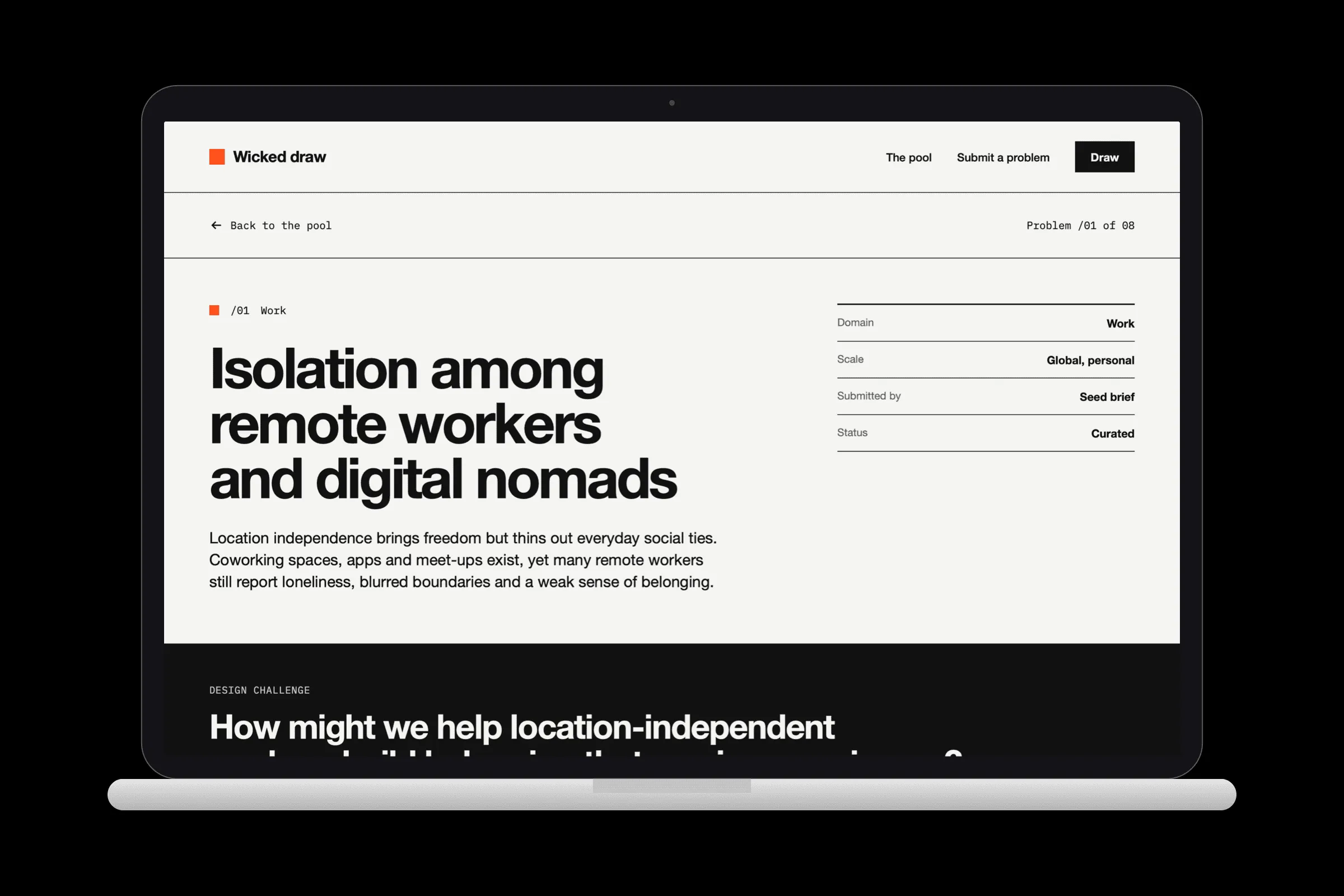
The problem and the challenge
Each brief states the context, the domain, the scale and who submitted it, and ends with a design challenge as a How might we question. For example: How might we help location-independent workers build belonging that survives moving on?
/02
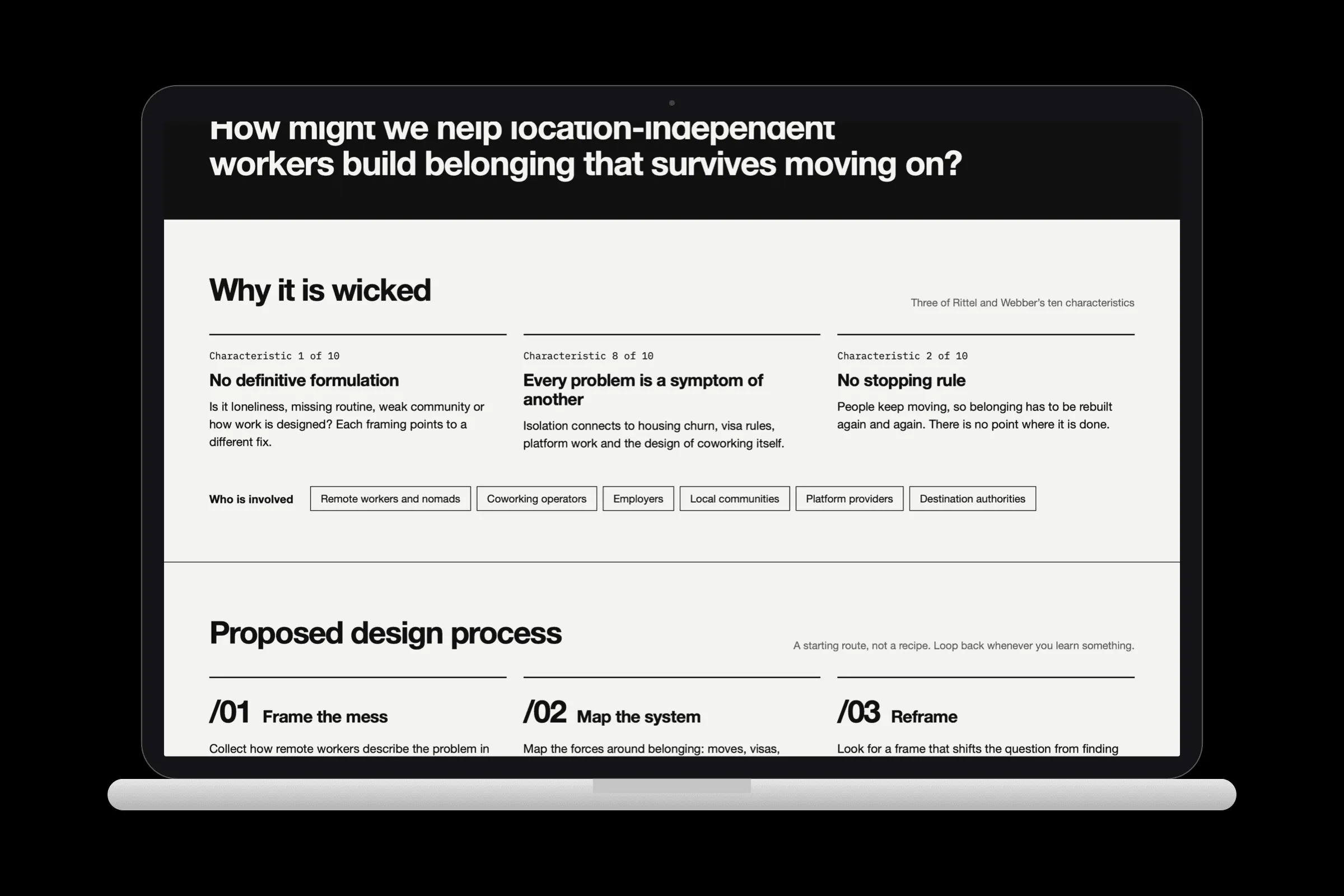
Why it is wicked
Three of Rittel and Webber’s ten characteristics, explained for the specific problem. Isolation among remote workers has no definitive formulation, is a symptom of other problems such as housing churn and visa rules, and has no stopping rule, because people keep moving.
/03
Principles
One draw, one problem. No rerolls until you have read the brief.
A route, not a recipe. The process is a place to start, not a checklist.
Sources behind every step. Nothing in the brief stands on opinion alone.
Develop
How the service guides a designer from a random problem to real work on it.
/01
The draw
One draw, one problem. No rerolls until you have read the brief. The home screen shows how many problems are in the pool and that every process has six phases.
/02
The pool
Eight curated problems across eight domains: work, food, housing, public services, health, cities, circularity and climate. You can browse instead of drawing, filtered by domain.
/03
From the outside in
Anyone can put a problem in the pool, ideally one they or the people around them live with.
You describe it. The problem in one sentence, what is happening and why it is hard, who is affected.
A process and sources are drafted.
A curator reviews the brief and adds problem-specific sources.
It joins the draw.
/04
A proposed design process
A starting route, not a recipe. Six phases, each with an action tailored to the problem and suggested methods: frame the mess, map the system, reframe, co-create, probe, and learn and adapt.
/05
Sources
Sources on the problem itself, plus core reading on wicked problems and process, from Rittel and Webber (1973) and Buchanan (1992) to Dorst’s frame innovation, Meadows’ leverage points, the Design Council’s Double Diamond and the 100metod library.
Deliver
The final interface puts the real voice of the problem first.
/01
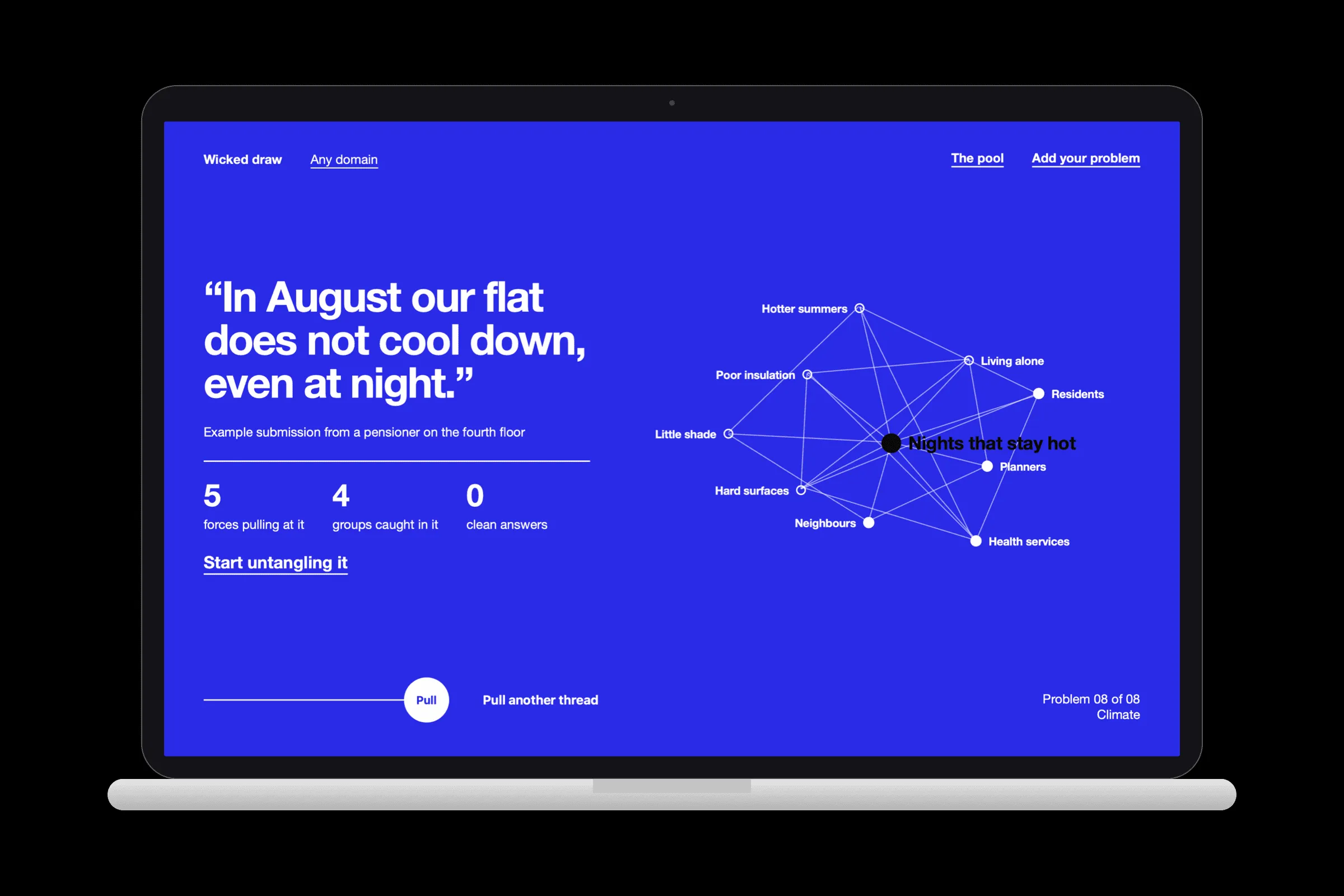
The tangle
Each problem appears as a submission in the voice of someone who lives with it, next to a living map of the forces pulling at it and the groups caught in it. The map drifts and pushes away from the cursor, and pulling another thread re-tangles it.
The counts sum it up: forces pulling at it, groups caught in it, and zero clean answers. Then the brief and the process take over and guide you to the first step.
© More works
(WDX®)
digital design



© help centre
(WDX)
clarification


Let’s talk