Design Thinking × AI

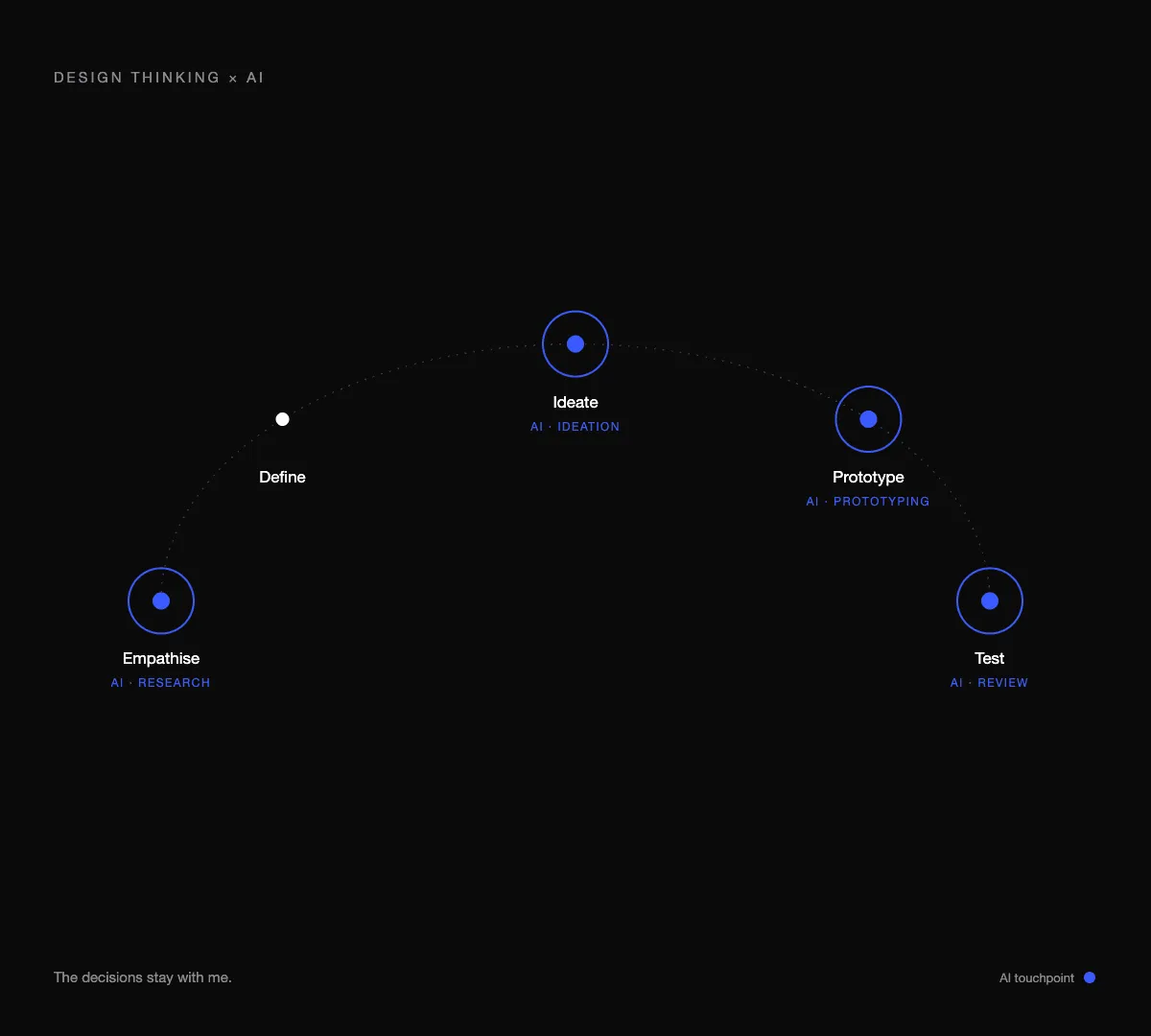
I use AI in three places in my design process: research, ideation and prototyping, and review. The decisions stay with me.

Category:

Design Thinking @ AI

Author:

Pavel Danyi

Read:

3 mins

Location:

Prague

Date:

Jul 21, 2025
Research

I use AI in three places in my design process: research, ideation and prototyping, and review. In each of them it does the first pass and I do the deciding. That split matters more to me than which tool I happen to use.

The first pass

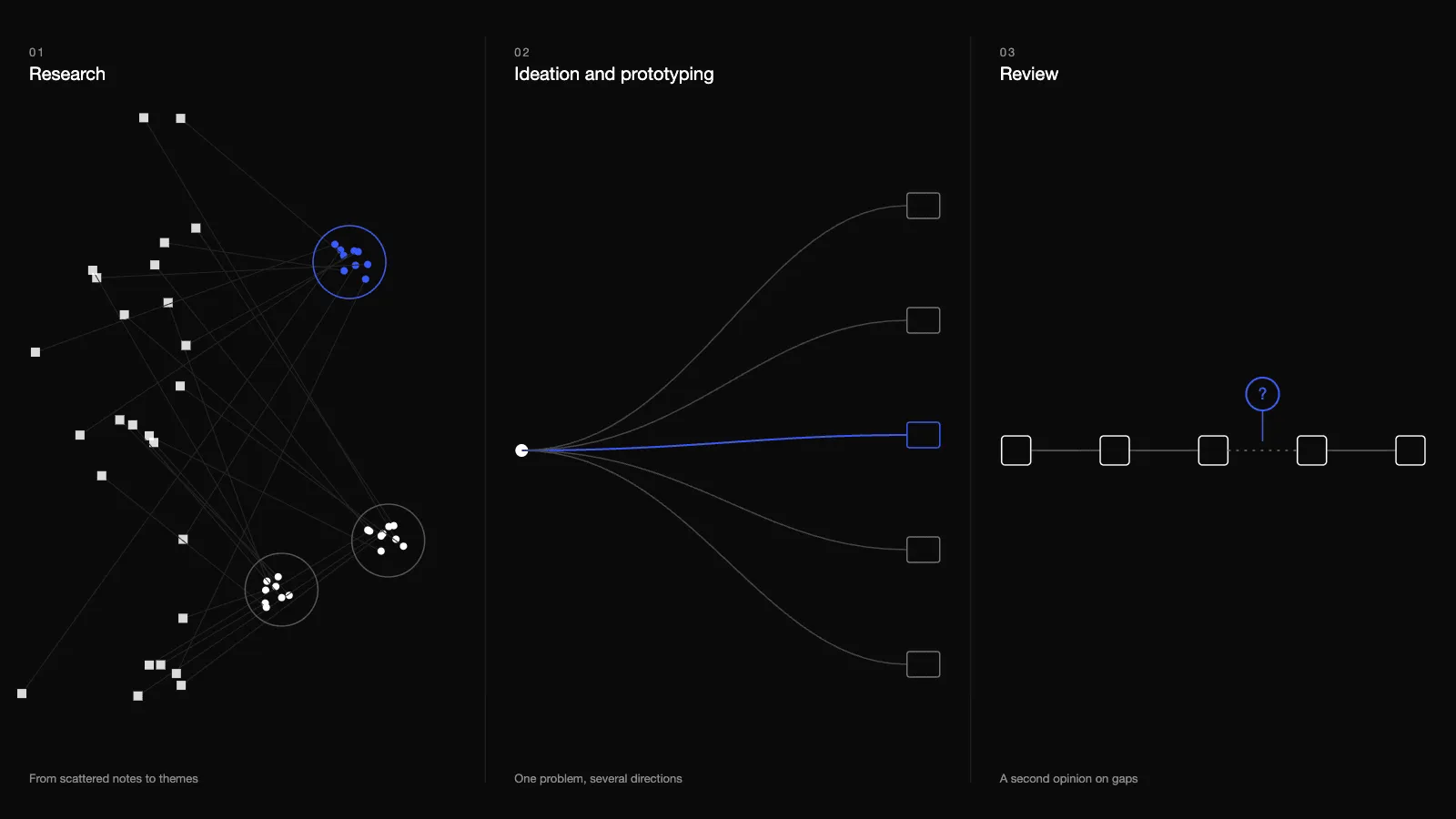
AI does the first pass over interview notes, transcripts and survey answers. It finds recurring themes, groups comments and points to what deserves a closer look. On a large pile of open answers, that turns a blank page into a list of candidates I can check.

Before I decide anything, I go back to the source material. A summary is a claim about the data, not the data itself. Models tend to smooth over the odd, contradictory comment, and in research the odd comment is often the finding. So every theme the model suggests has to survive a reread of the quotes behind it.

What it can’t replace

AI can help me read what people said. It can’t say it for them. Nielsen Norman Group reran studies they had already done with real participants, this time with AI-generated “synthetic users”, and found the answers too shallow and too positive. In one study, real learners often started online courses and never finished them, while the synthetic learners reported completing everything.

That is exactly the kind of gap a product team needs to see. Synthetic answers can help with desk research and early hypotheses. They don’t replace talking to the people who will use the thing.
Ideation and prototyping

Reframing

When I’m stuck between a problem and a solution, I ask it for other framings and user scenarios. Rewriting one How Might We question five different ways often shows me that I had quietly built a solution into the question itself.

Breadth before polish

When prototyping, I quickly generate several flows, copy options or visual directions and compare them, instead of polishing the first idea. The value isn’t in any single output, it’s in the spread. With ten versions side by side it’s much easier to say why one of them is better, and that reasoning is what I bring to the team.

Prototypes that run

AI coding tools also changed what a prototype can be for me. Several case studies on this site include coded, clickable prototypes instead of static screens. That lets me test real interactions, real copy and real data earlier, while changes are still cheap.

Review

I give it a flow or an early concept and ask for gaps and hidden assumptions. Sometimes it confirms what I thought, sometimes it finds something new, and sometimes the answer is useless. Then I have to explain why I disagree, and that helps too: arguing with a reviewer is a quick way to find out whether I can actually defend a decision.

When AI is part of the product

In Neurofacts, AI isn’t only a tool I used, it’s part of the experience: a chat that answers questions about one brain fact at a time. There the design work was mostly about limits. A short list of rules is rebuilt for every fact, so the model answers only from well-supported findings, keeps established and debated evidence apart, stays on the fact, and never turns into health advice.

Designing what an AI must not say is as much a part of the interface as the screens around it.

What stays with me

The decisions. AI makes options cheap, which makes judgement the expensive part. Choosing which theme matters, which framing is honest and which flow is worth testing is still the job.

Tools I use: Claude, ChatGPT, Gemini, Cursor.

Sources

Nielsen Norman Group. Synthetic Users. nngroup.com/articles/synthetic-users

© More articles
(Notes)
Creative notes
© help centre
(WDX)
clarification

FAQ.

Pavel Danyi

Defining outcomes through a transparent process and honest dialogue.

01

What services do you offer?

02

What is your typical turnaround time?

03

How do you identify what users truly need?

04

Why invest in research instead of jumping straight into design?

05

What exactly is the "output" of your work?

What services do you offer?

What is your typical turnaround time?

How do you identify what users truly need?

Why invest in research instead of jumping straight into design?

What exactly is the "output" of your work?

Pavel Danyi

Let’s talk