About:
Mind Atlas distils 87 techniques from neuroscience and cognitive psychology into 44 methods for UX and service designers, researchers and product teams, plus 18 add-ons to existing methods of 100metod. It is built for designing services around how people actually perceive, remember and decide.
Every method stands on a documented mechanism and comes with step-by-step instructions (198 in total), an example of the output, an honest evidence grade and links to the studies behind it: 141 sources across the collection.
Category:
Research
Year:
2026
Design framework:
Double Diamond, cognitive science
Research
Define
Develop
Deliver
The problem:
Research on the human mind keeps growing, but it is scattered across academic journals and rarely says what a designer should actually do on a project. Many design decisions still rest on the team's experience and taste, and usability tests run with calm, rested users rather than the tired, stressed and interrupted people who use services in real life.
Goal:
Build a bridge from research to practice: turn findings about attention, memory, emotion and decision-making into concrete methods for each phase of a project, and say openly how well each one is proven.
My role:
Author of the collection. Literature research, writing every method, grading the evidence, three rounds of audit, the information architecture and the design of the website.
Methods:
•
Literature review
•
Method template
•
Evidence grading
•
Double Diamond mapping
•
Overlap audit
•
Information architecture
•
Search by problem
•
Source referencing
Discovery
Connecting neuroscience with the design of technology is no longer a niche topic. Research keeps growing and practice is interested, but the step from a study to a project is missing. The project began as a research structure called Neurometody.
/01
A missing bridge
2003. Raja Parasuraman named neuroergonomics, the study of the brain at work with technology.
2007. NeuroIS was founded, bringing neuroscience into information systems research, with an annual conference since 2009.
2020. A review mapped 200 NeuroIS papers from 2008 to 2017, and Laws of UX brought psychology to designers in practice.
Today. Studies stay scattered and rarely say what exactly a designer should do. The collection tries to be that bridge.
/02
Building on 100metod
The collection follows 100metod from the Department of Information and Library Studies at Masaryk University, where I studied Information Services Design. 100metod shows which methods a designer has. Mind Atlas asks what research on the human mind says about designing services.
It doesn't repeat 100metod. It contains only methods that aren't described there.
/03
The first structure: 62 methods
The collection started as a working structure called Neurometody: 62 methods for researching, designing and validating services, each written around one documented mechanism, with its sources and a verification status. They fell into five groups: Discover (16), Define (11), Design (13), Validate (8), and Team and designer (14), resting on 140 sources.
Define
The methods don't replace interviews, usability tests or personas. They add to them where asking and observing isn't enough.
/01
What makes it different
It doesn't rely only on what people say. Memory rewrites accounts and people often don't know why they decided. Methods compare words with behaviour.
It counts with people's real state. Fatigue, stress, interruptions and limited attention, the conditions in which services are actually used.
Every step has a documented reason. Each method explains the finding it stands on, with links to specific studies.
It says openly what is proven. Every method carries a status.
/02
Honest evidence grading
Proven by research (16). The procedure itself was studied and works, sometimes in a related field such as healthcare or project management.
Established in practice (17). A common procedure in design, research or human factors. The mechanism is documented, the procedure hasn't been measured systematically.
New proposal (11). Derived from a documented mechanism but not yet studied as a method. These need to be tried first.
Develop
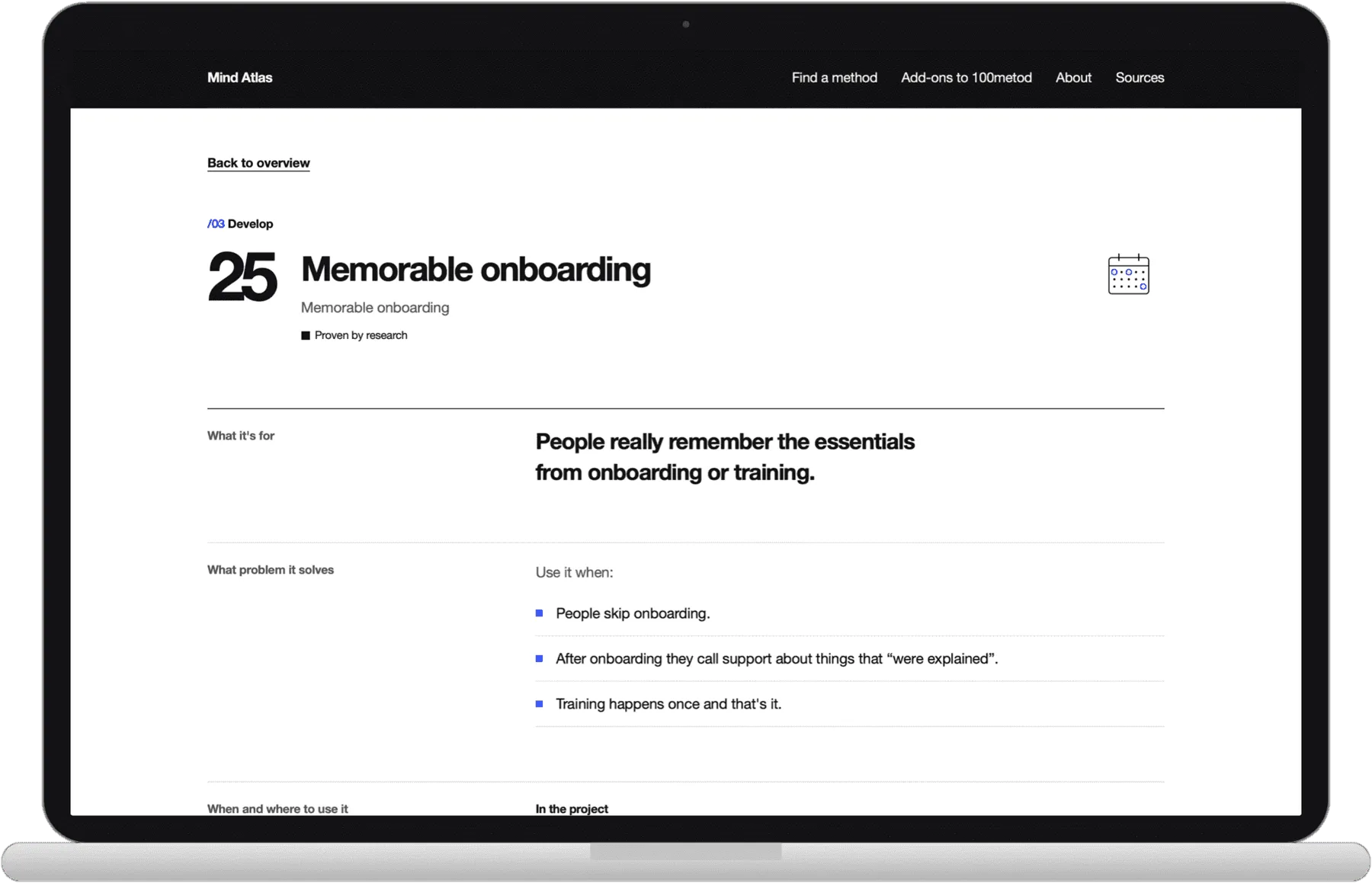
Every method follows the same anatomy, so a designer can tell at a glance what it solves, how to run it and how much to trust it.
/01
Method anatomy
Each method has its mechanism in one sentence, the problem it solves, when and where to use it, the steps, the output, the cost in time and materials, ethical notes where needed, a verification status and two groups of sources: research on the mechanism and on the procedure itself.
/02
Organised by the Double Diamond
The phases follow the Double Diamond published by the British Design Council in 2005: Discover, Define, Develop and Deliver, with 9, 9, 13 and 5 methods. Methods for the team and the designer, 8 of them, aren't a fifth phase. They fit anywhere in a project.
Validation is the smallest group, because 100metod already describes most testing procedures and their cognitive findings live in the add-ons.
/03
Find a method by problem
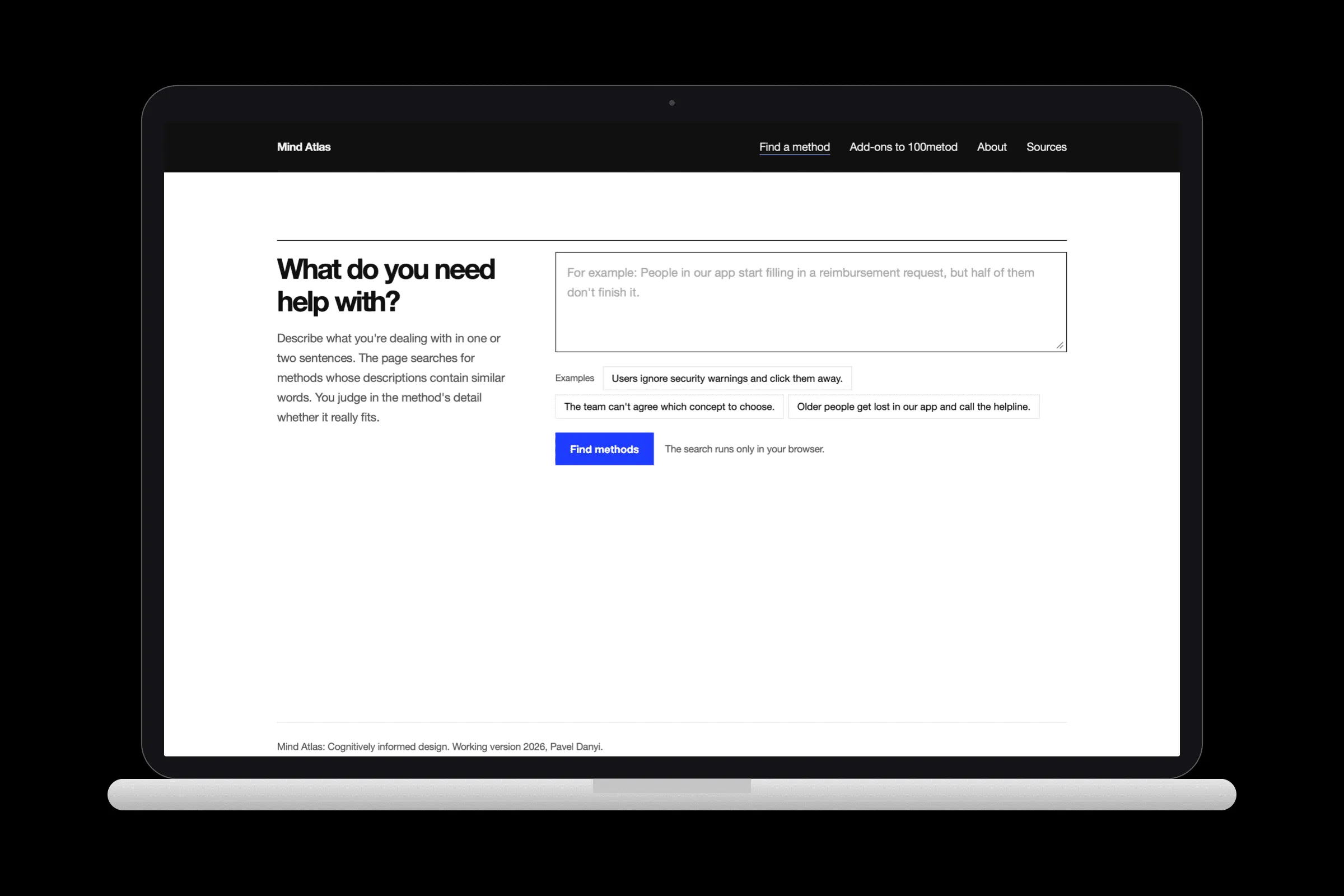
Designers rarely start from a method name. They start from a problem. The finder takes one or two sentences, such as “users ignore security warnings and click them away”, and suggests methods whose descriptions use similar words. The search runs only in the browser.
Deliver
The collection went through three rounds of audit. In the last one I compared it with 100metod and removed every method that overlapped.
/01
Audit
62 methods in the first structure.
20 merges of methods that described the same thing.
18 moved to add-ons because they overlapped with 100metod.
44 methods in the final collection, citing 141 sources.
/02
Add-ons to 100metod
The cognitive findings of the removed methods didn't disappear. They are attached as add-ons to 15 methods of 100metod, such as in-depth interviews, personas or the five second test, with a link to the original method.
/03
Sources
Every method has two groups of sources: research on the mechanism, and research or literature on the procedure itself where it exists. Each source links to a Google Scholar search.
Outcome
Mind Atlas is a working version from 2026. Methods marked as new proposals still need to be tried in practice.
/01
Where the evidence is thinner
The audit names where support is weaker: research on the uncanny valley is inconsistent, the link between sleep and creativity rests on few studies, and the effect of short breaks varies between studies.
/02
Next steps
Try 3 to 5 new-proposal methods on a real project and note what didn't work.
Verify citations against the originals before public release.
Show the add-ons to the 100metod team and explore linking them to their methods.
© More works
(WDX®)
digital design



© help centre
(WDX)
clarification



Let’s talk