01 · FUNCTIONAL LONELINESS
Weekly ritual of mutual responsibility
Accountability partner
Weekly ritual of mutual responsibility
When to use it
It's Sunday. You open Zoom and tell one person what broke this week.
About:
Digital nomadism is sold as freedom, and the feed looks like paradise. Underneath, a specific kind of strain builds: isolation inside a community that turns over fast, pressure to keep performing the dream, and none of the safety net an employer or a home country usually provides. Coworking spaces are the one stable place a nomad keeps returning to, yet they offer fast Wi-Fi and good chairs and no structured way to notice someone struggling.
This project designs that missing layer, a non-clinical support step that helps a space catch strain early and hand off to real help, without ever taking on a clinical role. This case study deals with psychological strain and suicide risk among people living far from home. It uses published figures and studies, never individual cases. If any of this is close to you right now, please contact a local crisis line.
Category:
Service design
Year:
2026
Location:
Bali, Indonesia
Design framework:
Design thinking
Tools:
Miro, Notion, Figma, Google Workspace, Typeform
Wellbeing
Support
Mental health
Experience
Bali is a global hub for digital nomads, and the posted version of that life hides the other side of it. Physically surrounded by people, many nomads still deal with isolation, burnout and the uncertainty of temporary stays. The spaces they work from provide high-speed internet and ergonomic chairs, but no structured, non-clinical way to respond when someone is struggling, so strain builds unnoticed and unspoken.
Run a service design research phase to understand the real causes of nomad isolation and the gaps in coworking environments, then define a non-clinical support model that helps local staff notice signs of strain and make a warm handoff to professional help, without needing clinical expertise or taking on clinical responsibility.
Sole service designer and researcher across the whole project. I set the ethical framework, ran the autoethnographic fieldwork as a nomad in Bali, conducted and thematically analysed the interviews, and designed the model and its artefacts.
•
Double Diamond framework
•
Thematic analysis
•
Analytical autoethnography
•
Affinity mapping
•
Desk research
•
Service journey mapping
•
Netnography
•
Card-based concept validation
•
Staff questionnaire (Typeform)
•
Warm handoff principle
•
Semi-structured interviews
•
Research ethics and consent
The project did not begin as a research topic. It began as something I was living. I use that insider position as method, analytical autoethnography, and build outward from it: my own experience first, then a check that the strain is real, then the spaces that host it, and finally the nomads themselves.
I started working remotely and, over time, living as a digital nomad, mostly around Bali. Long before it was a thesis, it was my own daily life: the freedom the lifestyle promises, and the quieter strain underneath it that the feed never shows. Rather than study this from the outside, I treated my own experience as the starting point, analytical autoethnography, and used it to decide what to look at next.
The next question was whether this was just me. It was not. Desk research on nomad wellbeing, remote work and coworking showed the same pattern: a busy community does not guarantee support when someone needs it. Online, people vent to strangers rather than to anyone nearby.
Before taking a topic this sensitive into the field, I ran it past my supervisor and three advisory consultants. Their input shaped the safeguards used throughout: informed consent, voluntariness, no clinical data and a clear route to professional help.
Then the spaces. A questionnaire with staff and management at B Work, At06 and others showed that none had a formal system. Support was informal and depended on whether someone happened to notice.
Then the nomads themselves. Ten semi-structured interviews of 15 to 45 minutes, held privately and one to one between January and April 2026, with informed consent and a clear route to professional help for anyone in real distress.
The most useful finding: strain does not build evenly. The first weeks run on novelty. Around the third to fourth month, once the newness fades but deeper relationships have not formed, a clear dip appears, matching Oberg's U-curve of cultural adaptation. This is where support is needed most and available least, and it is the gap the model has to fill.
Define turned the discovery material into a brief: the four themes the strain clusters into, the exact gap where support fails, who the model is for, and the principles it has to hold.
Grouping the interview and observation material produced the four themes the rest of the work is built on: functional loneliness, performance pressure, systemic neglect and reputational risk. The themes were not counted for frequency but used to understand how people relate to different kinds of support, and the intervention cards were later organised around these same four.
Across the four themes, one gap kept surfacing. Between ordinary community small talk and expensive, inconsistent professional help, there was no obvious, low-threshold, non-judgemental door to knock on. The opportunity was to design that missing intermediate step, built on the principle of a warm handoff between the space and professional support.
To keep the design honest to the research, I drew an illustrative composite persona from the interviews rather than a demographic profile. A high-functioning nomad who performs wellbeing in public and struggles in private, who would sooner post anonymously than raise it in the space, because the barrier is not access but shame and the absence of a discreet route.
The user is not only that person. It is equally the staff member who notices something and has no idea what to do next. Everything after this point is designed for both.
The model works in three consecutive layers, so no single person carries more than they should. Notice: staff attentiveness to the quiet signals that a member is losing their footing. Support: low-threshold, voluntary help such as a buddy connection, a calm check-in, a reflection card or a discreet channel. Hand on: beyond community support, the person is directed to a vetted professional, a telehealth service or a crisis line. Orientation, dignity and a safe handover, never diagnosis or therapy.
With the four themes defined, Develop turned them into tangible support concepts and tested them with nomads, so the final model would rest on what people actually accept, not on what I assumed would help.
I built a deck of thirty intervention cards from the interview clusters and from thematic research on comparable forms of support. The cards were not a finished solution but a design stimulus, a way to make possible forms of support concrete enough to react to. Each card sits in one of the four themes: functional loneliness, performance pressure, systemic neglect and reputational risk.
It's Sunday. You open Zoom and tell one person what broke this week.
You arrive in Bali and book your stay for 8 weeks, not 2.
You can't focus alone. You log into Focusmate at 9am.
Your first day at the coworking Anna texts you for coffee.
Sunday 6pm. You walk to the coworking BBQ without checking who's coming.
Tuesday 7pm. You join a Hedepy group call with 6 other nomads.
You can't explain visa anxiety to a regular coach. You book a specialist.
It's 9pm. Your phone enters Focus mode no DMs until 9am.
Calendar says 9–12 BLOCKED. You ignore three Slack pings.
6pm. Write 3 wins, plan tomorrow, close laptop, walk away.
Your CEO emails at 11pm. You read it at 9am the next day.
A meeting is scheduled. You write a doc instead meeting cancelled.
Friday at noon you close the laptop. The week is done.
You sign up for Palouse Mindfulness this Monday. 8 weeks. Done.
Three months you've been exhausted. You book a burnout coach.
Before flying to Bali, you create a Hedepy account. Just in case.
Renewing your insurance? Check the mental health clause this time.
7am, before email. Ten minutes of Calm on your phone.
Not ready for a therapist yet. You open Hedepy self-help instead.
You call the company EAP. They don't tell HR. Three sessions paid.
You ask the front desk for Marek. He's MHFA-trained. You talk.
You tell the buddy. Buddy walks you to staff. Staff rings a therapist.
You don't want to explain 'what's a nomad' for 15 min. Book Trevor.
It's 3am, you're in crisis. You ring +62 811 3855 472. Someone picks up.
You can't tell anyone you know. You text a 7 Cups listener instead.
New Reddit account. You post in r/digitalnomad. Nobody knows it's you.
Every night, 5 minutes. You write what hurt today. Only you read it.
You take Wednesday off. The Slack message: 'sick day'. No follow-up.
Friday survey: 1 question, 1 emoji. Your boss sees the average, not you.
Your therapist lives in Prague. None of your Bali friends will ever meet her.
Every card shares one structure, so a reader sees at a glance what kind of support it is and when to use it. Top: an index number and its theme. Then the intervention name and a one-line principle. A “when to use it” block turns that principle into a concrete micro-situation. The footer states the level of support, from individual reflection through peer and community to professional, and the source it draws on.
I tested the deck one to one with a separate group of ten nomads at Tropical Nomad and B Work, deliberately different people from the interviews. Each card was a concrete support concept that participants could pick, set aside or push back on, naming the conditions under which a given form of support would feel safe. I ran it one to one rather than as a workshop, because the topic is sensitive and a group would have pushed people towards socially acceptable answers. This tested acceptability, credibility and ethical safety, not clinical effect.
Deliver translated those validated preferences into a non-clinical service model and a set of artefacts a coworking space could put into daily use, without any member of staff ever acting as a therapist.
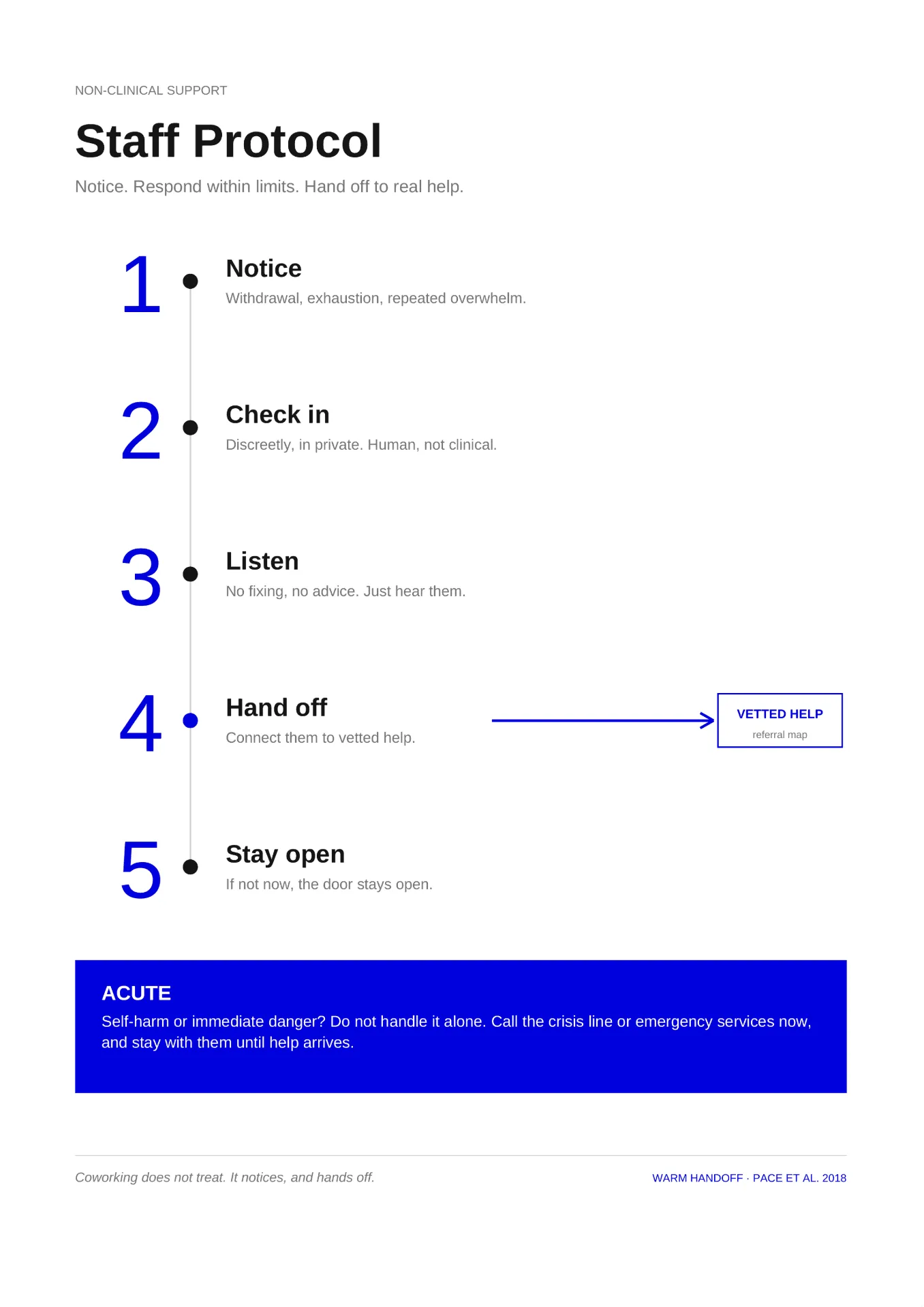
Five steps for the person who notices something: notice, check in, listen, hand off, stay open. It states plainly what staff do and where they stop, and an acute block on the same page says what to do if someone is in immediate danger. The handover principle comes from Pace et al. (2018).
A curated map of vetted local and online support, from licensed psychologists to telehealth and crisis lines, so staff never have to improvise where to point someone.
A wall poster carrying one honest line and a QR code, giving a member a private way to ask for a contact without saying it out loud. It answers the finding that the barrier is not access but shame.
A one-page threshold that spells out what the space does, and just as clearly what sits beyond the line for licensed professionals only, so the non-clinical role stays legible to staff and members alike.
Five questions on A6 cards, for the member alone. No one sees the answers. If the last card is a yes, it points to the discreet channel or the referral map. Grounded in expressive writing (Pennebaker, 1997).
The final model gives a coworking space a non-clinical, low-threshold way to notice a nomad in strain and connect them to real help, without any member of staff ever taking on a clinical role.
The participating coworkings received a complete, print-ready set: the service model, the staff protocol, the referral map, the discreet channel poster, the role boundaries sheet and the reflection cards, plus two card decks. Everything is written in English for international spaces and built to be used without a designer in the room.
The spaces now have a shared, non-clinical way to respond when a member is struggling: staff know what to notice, what to say and where their role ends. Validation with ten nomads showed which forms of support they would actually accept, so the model rests on evidence rather than assumptions.
Designing for wellbeing was as much about designing restraint as features. The hardest and most valuable decisions were about what the service should refuse to do, and putting that boundary into the artefacts themselves, not just the strategy, is what turns a good intention into something a space can act on. Doing the fieldwork as a nomad myself kept the whole thing honest, and it taught me to treat the limit of a design as part of the design.
Validated at concept level, the model now needs to run somewhere real: a pilot in one coworking space, watching whether staff use the protocol, whether members use the discreet channel and whether the warm handoff changes behaviour around the third to fourth month. Next come a short staff training format and a test of whether the model travels to other destinations.
Let’s talk